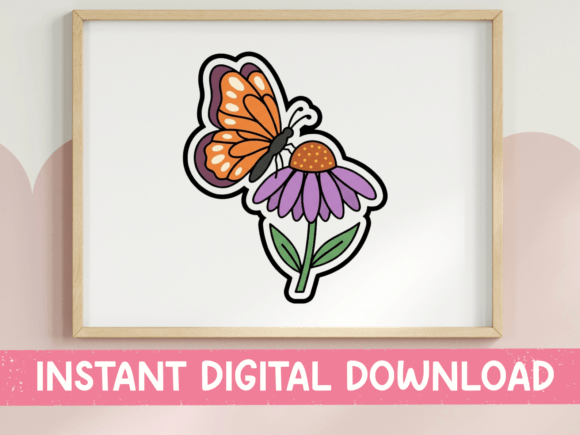
Monarch Butterfly on Purple Coneflower: A Botanical Illustration for Modern Makers
There’s a specific moment in mid-summer when the garden is at its loudest—a low hum of bees, the drift of milkweed fluff, and the silent, weightless descent of a monarch butterfly onto a purple coneflower. This digital illustration captures that precise instant. The composition is straightforward: a monarch, its wings a stained-glass arrangement of orange and black veins, rests on the broad, drooping petals of a purple coneflower. The flower’s center is a warm, textured brown, a sturdy anchor for the delicate visitor. The green stem and two small leaves provide a clean, supporting structure. What makes this asset work is its botanically grounded style. It’s not a cartoonish simplification or an overly stylized abstraction. The colors are rich and true to nature, the lines are confident yet organic, and the overall feel is one of quiet observation. This is the kind of illustration that feels both timeless and immediate, appealing to anyone who has ever paused to watch a butterfly.
As a design asset, the Monarch Butterfly on Purple Coneflower graphic carries a particular personality. It speaks of careful craftsmanship, an appreciation for natural detail, and a gentle, warm aesthetic. Its style bridges the gap between classic botanical art and contemporary flat illustration, making it incredibly versatile. The visual hierarchy is clear—the butterfly is the undeniable focal point, with the coneflower providing a complementary stage. This clarity is what makes it so useful across different mediums. It’s not trying to be everything at once; it’s a focused, well-executed piece that can elevate a project without overwhelming it.
Practical Applications for Creators and Businesses
The true value of a well-crafted illustration like this lies in its adaptability. For designers and entrepreneurs, it’s a ready-made piece of visual storytelling. Think beyond the obvious nature journal. This graphic can form the core of a spring or summer marketing campaign for a local nursery, a boutique tea brand, or an eco-friendly skincare line. Its natural elegance lends itself beautifully to packaging design—imagine it on a seed packet, a soap wrapper, or a label for artisan honey. The illustration’s balanced composition ensures it works well as a central motif or as a repeating pattern element.
For crafters and hobbyists, the included SVG and PNG files open up a world of production possibilities. The SVG is fully scalable, making it perfect for vinyl cutting with a Cricut or Silhouette machine. Create precise decals for water bottles, laptop skins, or car windows. Use it to cut intricate stencils for painting on wood signs or fabric. The high-resolution PNG with its transparent background is ideal for sublimation printing. This means you can transfer the design permanently onto mugs, tote bags, t-shirts, and ceramic tiles with professional results. It’s also perfect for digital projects: use it as a hero image on a blog post about pollinator gardens, as a standout sticker in a digital planner, or as part of a social media graphic to announce the arrival of spring. The application is limited only by the project’s needs.
Integrating Nature-Inspired Graphics into Your Brand Identity
Consistency is the backbone of strong brand identity. When you find a design asset that aligns with your brand’s values—say, a love for nature, craftsmanship, or sustainability—integrating it across touchpoints builds recognition. The Monarch Butterfly on Purple Coneflower can become a recognizable element for a brand that wants to evoke these feelings. Use it consistently on your product tags, website header, and social media profiles. It works particularly well for brands in the wellness, gardening, education, or artisanal food spaces. The key is to use it with intention. It can serve as a secondary logo element, a watermark, or a recurring decorative motif in your editorial design layouts.
From a technical standpoint, the files provided are built for real-world use. The SVG file is compatible with all major design software, including Cricut Design Space, Silhouette Studio, Adobe Illustrator, and the free alternative Inkscape. This means whether you’re a professional designer using industry-standard tools or a hobbyist working with a desktop cutting machine, you can open and manipulate the file without hassle. The PNG file’s high resolution ensures it prints cleanly at larger sizes, which is crucial for sublimation and quality printing. Always remember to do a test print or cut, especially if color accuracy is critical for your project. Screen colors and printer outputs can vary, so a quick test run is a professional’s best practice.
Choosing and Using Your Design Asset
Before committing this illustration to a major project, consider its context. Does its color palette harmonize with your existing brand colors? The warm oranges, deep purples, and earthy browns are generally complementary, but a quick mockup in your design software is wise. Evaluate the visual weight of the illustration. Its detailed, hand-drawn nature means it pairs best with simpler, cleaner fonts—think a modern sans-serif for body text or a simple serif for headings. Avoid pairing it with overly ornate or script fonts, as that can create visual clutter. The goal is to let the illustration shine while maintaining overall readability and a professional polish.
This Monarch Butterfly on Purple Coneflower asset is more than just a pretty picture. It’s a versatile, professional-grade tool for creators who understand the power of natural imagery. It offers a way to inject authenticity, warmth, and a sense of craftsmanship into your projects, whether they are destined for a digital screen or a physical product. It’s a nod to the beauty of the natural world, packaged in a format built for the modern maker’s workflow.