I Asked Myself If I’m Okay Skeleton PNG: A Design Deep Dive
Finding a design asset that genuinely captures a mood without feeling forced is rare. The "I Asked Myself If I’m Okay And We Both Started Laughing" skeleton PNG is one of those rare finds. It’s not just a graphic; it’s a wearable piece of relatable, dark humor that has found a massive audience online. This design perfectly taps into a specific cultural moment where self-deprecating jokes and spooky aesthetics collide. For designers, crafters, and small business owners, understanding the anatomy of its appeal is key to using it effectively.
The Anatomy of Relatable Chaos
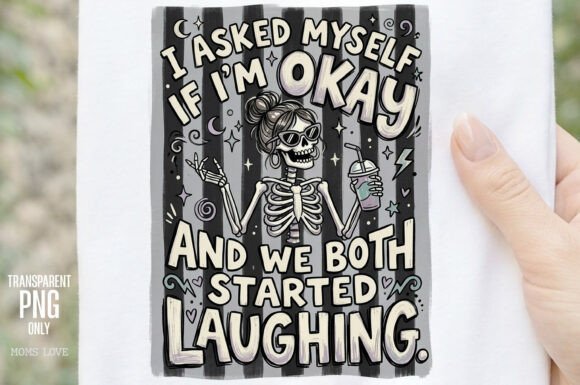
At its core, this design works because it tells a tiny, complete story. The central character isn't a scary, grim-reaper skeleton. It's a stylish, almost casual figure with a messy bun, trendy cat-eye sunglasses, and an iced drink. This immediately transforms the skeleton from a symbol of death into a symbol of a relatable, over-caffeinated, and slightly chaotic modern life. The hand-drawn, sketch-style aesthetic gives it an authentic, boutique feel, avoiding the sterile look of perfect vector art. It feels personal, like a doodle you’d find in a cool notebook.
The typography is the other half of its success. The stacked, oversized hand-lettered text is impossible to ignore. Its creamy off-white color with lavender shading and thick black outlines creates a bold, dimensional effect that pops off any background. This isn't a standard premium font; it's custom lettering that’s integral to the art. The quote itself is the punchline, and the design delivers it with confidence. The surrounding elements—celestial sparkles, doodled moons, and tiny hearts—aren't clutter. They build a "magical spooky boutique" atmosphere, making the entire composition feel cohesive and intentional.
Where This Graphic Truly Shines: From Apparel to Branding
The versatility of the I Asked Myself if I’m Okay Skeleton PNG is one of its greatest strengths. Its primary use is, of course, apparel. It’s a natural fit for t-shirts, hoodies, and sweatshirts, especially for brands catering to the gothic, emo, or alternative fashion scenes. Its dark charcoal and gray striped background provides a built-in design element that works well on both light and dark garments, simplifying the printing process.
Beyond apparel, its applications are extensive for anyone in the creative space:
- Craft Projects: Perfect for sublimation on mugs, tote bags, and phone cases. The PNG format makes it easy to layer and resize for various projects.
- Social Media Graphics: As a standalone image or part of a larger post, it’s instant engagement bait. It communicates a specific brand personality—sarcastic, humorous, and trendy—without a word of caption.
- Stickers and Pins: Its bold outline and defined shape make it ideal for die-cut stickers or enamel pin designs.
- Website and Blog Elements: For a lifestyle blogger or a brand with a similar voice, it can be used as a featured image, a sidebar graphic, or in a newsletter to add personality.
Think of it less as a single image and more as a piece of a brand identity. A small business selling alternative home goods or sarcastic greeting cards could use this design as a seasonal cornerstone, building a marketing campaign around its aesthetic. It’s a ready-made piece of editorial design for Halloween content or a fall collection launch.
Integrating the Aesthetic: Practical Design Guidance
Using a highly stylized graphic like this requires a thoughtful approach to maintain professionalism and clarity. Here’s how to make it work for you.
Evaluating Project Fit: First, be honest about your audience. This design has a strong point of view. It resonates with adults (20–50) who appreciate niche humor, alternative aesthetics, and don’t take themselves too seriously. If your project is for a corporate client or a formal event, this isn’t the right asset. But for a brand that wants to build community through shared, self-aware jokes, it’s a goldmine.
Font Pairing and Readability: Since the typography is baked into the PNG, you don’t need to pair it with another font for the main message. However, if you’re using it alongside other text (e.g., on a website or in a product description), choose complementary typefaces carefully. A clean, neutral sans serif font or a simple serif font can provide a calm counterbalance to the graphic's chaotic energy. Avoid pairing it with other script fonts or handwritten fonts, as this will create visual noise and harm readability. The goal is to let the skeleton PNG be the star.
Testing and Licensing: Always check the licensing terms of the PNG file before commercial use. Most reputable marketplaces offer clear licenses for print-on-demand and physical product creation. Do a test print or mockup to see how the colors translate. The subtle lavender shading and textured highlights are key to its charm, and you want to ensure they reproduce accurately on your chosen material, whether it’s cotton fabric or ceramic.
The "I Asked Myself If I’m Okay" skeleton is more than a Halloween novelty. It’s a masterclass in blending gothic humor with modern typography and character design. It shows how a creative font—in this case, custom lettering—can be inseparable from the artwork, creating a unified piece that speaks directly to a specific audience. For designers and creators, it’s a lesson in the power of personality. Sometimes, the most effective design asset isn’t the most versatile, but the one that feels the most authentic.